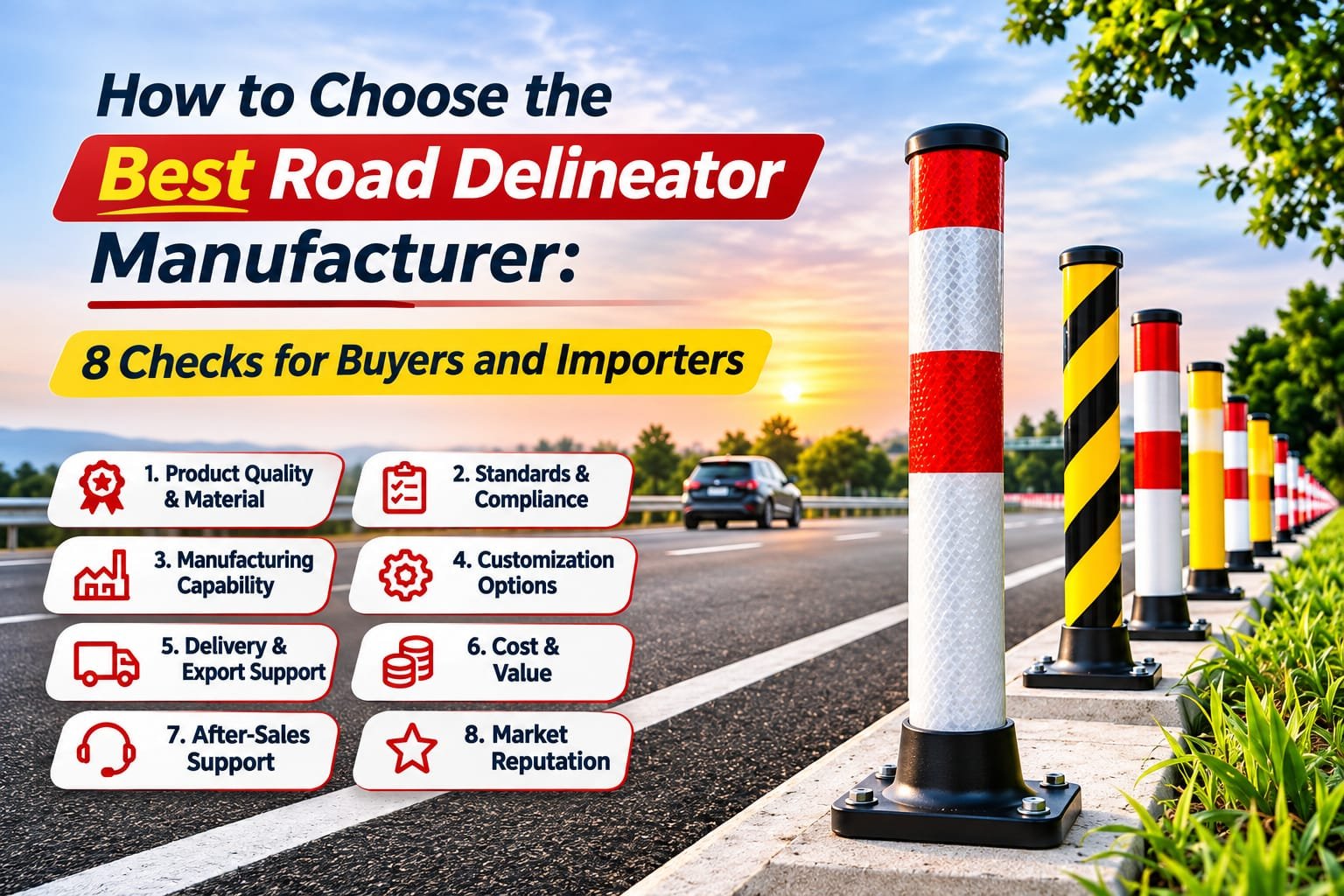
A single missing or faded post can turn a curve into a blind spot. That is why every serious road project needs a dependable road delineator, and why the manufacturer behind it matters as much as the product. This guide shows buyers and importers how to judge a supplier before placing an order.
You will learn what these posts do, which types and materials exist, and eight practical checks to run on any manufacturer. You will also see how installation works and what to consider when buying locally or in bulk. LTS Road Safety shares these points to help you compare suppliers fairly.
What a Road Delineator Does and Where It Is Used
A road delineator is a post or marker placed along the edge, median or centre of a road to show its alignment. It gives drivers a clear visual guide at night, in fog and on curves, where painted lines alone may fade or disappear. Many buyers also call them road safety delineators or delineator posts.
They appear on highways, expressways, hill roads, bridges, flyover approaches, junctions, medians and toll plazas. Industrial campuses and parking areas use them to guide traffic and protect edges. Flexible posts also help separate lanes at junctions without the damage that rigid barriers suffer.
Types and Materials Buyers Compare
Flexible spring posts use a polyurethane or similar polymer body on a base plate, so they bend under impact and spring back. They suit medians and junctions where vehicles may strike them. Rigid posts, often moulded plastic or ABS, cost less but may crack when hit.
Metal posts, including mild steel designs, offer strength and are common on roadsides. Solar versions add flashing LEDs for extra visibility. Reflective sheeting or reflectors on the post give passive visibility under headlights.
Material choice follows the road. Busy medians favour flexible posts, rural curves favour solar or retroreflective posts, and edges that rarely face impact can use simpler designs. Match the product to its role, not just to the price.
Eight Checks Before You Choose a Road Delineator Manufacturer
Use these eight checks to judge a maker before you commit. They apply to a road delineator supplier in India or abroad, and they work for single projects and bulk orders.
Check 1: Material and Construction
Ask what the post is made of, and request details such as polymer type, hardness, UV stabilisation and base plate material. Good flexible posts use UV-protected material that resists cracking and fading. The base should be thick, well moulded and drilled for firm anchoring.
Check 2: Reflective Sheeting and Visibility
Visibility depends on the sheeting grade, its adhesion and its placement. Ask which retroreflective grade the maker uses, whether it is bonded or taped, and how it holds up in sun and rain. Poorly bonded sheeting peels within a season and leaves a dull post.
Check 3: Standards and Compliance
Many Indian projects refer to IRC 79 and MoRTH specifications for delineators. Ask the manufacturer which standards its products follow, and request the supporting test reports or documents. Check the issuing agency and the date, and confirm current requirements with your project authority. LTS Road Safety advises treating a standards claim as incomplete until the paperwork is in your hands.
Check 4: Impact Recovery and Durability
A flexible post must return to the upright position after being struck. Ask for a demonstration or test video, and test a sample yourself by bending and releasing it several times. Look for cracks, permanent bending and spring fatigue. Durable posts keep their shape after repeated hits.
Check 5: Solar Models and Battery Claims
If you want solar units, ask for the LED type, flashing rate, battery capacity, solar panel rating, ingress protection and expected backup hours. Compare claims across suppliers on the same basis. A quality unit should charge reliably in daylight and keep working through the night in low-light weather.
Check 6: Sampling and Quality Control
Order samples and inspect them against the written specification. Ask how the manufacturer checks each batch, including sheeting adhesion, dimensions, colour and weight. LTS Road Safety suggests a trial installation on a short stretch, since real traffic reveals problems that a desk review misses.
Check 7: Supply Capacity, Packing and Delivery
Confirm production capacity, minimum order quantity and lead time in writing. Ask how posts are packed, because poor packing leads to scratched sheeting and bent bases in transit. Importers should also check labelling, documentation and shipping support.
Check 8: Price, Warranty and After-Sales Support
Compare quotations on identical specifications. A low price often hides thinner material, weaker sheeting or smaller bases. Ask for the warranty terms, the process for replacing defective units and the contact person for support after delivery.
How Road Delineators Are Put in Roads: Installation Basics
How road delineators are put in roads depends on the post type, but the steps are similar. Surveyors mark the positions along the edge, median or curve according to the road design. Crews then clean the surface and drill holes for anchors if the base plate needs bolting.
For flexible posts, workers usually fix the base with anchor bolts or approved adhesive, tighten it evenly and check that the post stands vertical. Solar units need clear access to sunlight, so avoid shade from barriers and trees. Traffic management is essential during the work.
After installation, check alignment, reflector direction and firm anchoring. Follow the manufacturer’s instructions and your project’s design for spacing, height and colour. A short inspection after the first rains catches loose fixings early.
Sourcing From a Road Delineators Supplier in Delhi NCR
Local sourcing brings practical benefits. A supplier in Delhi NCR can arrange sample visits, quick dispatch and fast replacement, which helps projects with tight timelines. Winter fog across north India also raises demand, so reliable stock matters.
Visit the workshop if you can. Look at moulding quality, sheeting application, storage and inspection routines. Meet the team and discuss delivery schedules for your site. Speak to LTS Road Safety or any supplier on your shortlist about lead times before the busy season begins.
Wholesale and Export Buying for Distributors and Importers
Wholesalers and distributors buy on consistency. Look for a manufacturer that offers stable quality across batches, clear price tiers and dependable stock. Ask for a catalogue with heights, colours and models, so your customers can choose easily. For a road delineators wholesaler in India, repeat orders and reliable supply matter more than a one-time low price.
Importers face extra steps. Check export packing, carton labelling, documentation and shipping terms. Ask for test reports and product samples before you commit to a container. LTS Road Safety offers delineator posts for suppliers, wholesalers, distributors, exporters and importers, and you can discuss your requirements with the team before ordering.
Maintenance and Replacement
Inspect posts regularly. Look for faded or peeling sheeting, cracked bases, bent springs and tilted posts. Clean reflective surfaces to remove dust and mud, since dirt cuts visibility sharply.
Replace damaged posts promptly. A broken delineator leaves a gap in the guide line, and drivers rely on the pattern being complete. Keep spare posts and hardware in stock so repairs do not wait for the next order.
Record the installation date and batch details. This helps you track performance and claim warranty if a batch underperforms.
Frequently Asked Questions
What is a road delineator?
A road delineator is a post or marker placed along a road to show its edge, median or curve. It helps drivers see the road alignment at night and in fog. Flexible, solar, metal and plastic versions are common.
How are road delineators installed on roads?
Crews mark the positions, clean the surface and fix the base plate with anchor bolts or approved adhesive. They then check that each post stands upright and that reflectors face traffic. Solar models also need clear sunlight.
Which delineator post is best for highways and medians?
Flexible spring posts suit medians and junctions because they bend and recover after impact. Solar or retroreflective posts work well on curves and unlit stretches. The best choice depends on traffic, road design and project requirements.
How do I check the quality of a delineator post?
Inspect the material, sheeting adhesion, base thickness and finish, and bend a sample repeatedly to test recovery. Ask for test reports and compare them with the specification. A trial installation gives the clearest picture.
Where can I buy delineator posts in bulk in India?
You can buy from manufacturers and wholesalers across India, including suppliers in Delhi NCR. Compare samples, quotations, lead times and warranty terms before you decide. You can also contact LTS Road Safety to discuss bulk requirements.
Which standards apply to delineator posts in India?
Many projects refer to IRC 79 and MoRTH specifications. Requirements can vary by project, so confirm the current ones with the authority or consultant. Ask the supplier for documents that support its claims.
Conclusion
Choosing the right road delineator manufacturer comes down to eight checks: material, sheeting, standards, durability, solar specifications, sampling, supply and support. Verify each with documents and samples, and compare quotations on identical specifications.
To discuss your requirements, contact LTS Road Safety today and request samples and a detailed quotation.